
Rhythm of the Northeast: The Instruments Behind the Dance
Focuses on the unique, handmade musical accompaniment that drives the performance. Readers will learn about the specific roles of traditional instruments like the kham (drum), sifung (bamboo flute), and serja (bowed instrument) in creating the dance's melody.
1/18/20262 min read
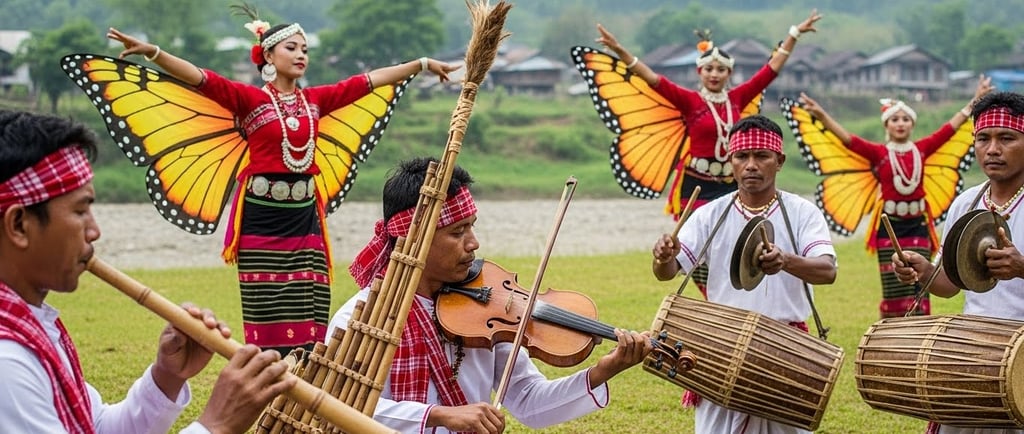
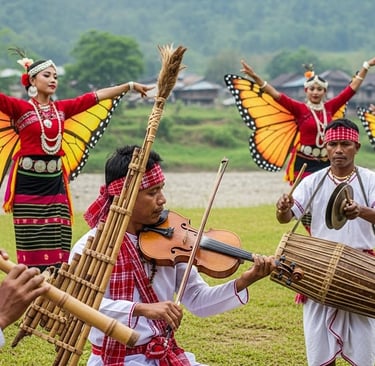
🥁 Rhythm of the Northeast: The Instruments Behind the Dance
While the Bagurumba is famous for its visual beauty—the "Butterfly Dance" of the Bodo tribe—its soul lies in its music. The performance is not driven by digital tracks or modern amplifiers, but by an organic orchestra of handmade traditional instruments.
These instruments are crafted from materials found in the forests of Assam—bamboo, wood, and animal skin—creating a sound that is deeply connected to the earth. Here is a guide to the unique instruments that drive the rhythm of the Northeast.
💓 The Kham: The Heartbeat
The most powerful sound in the ensemble comes from the Kham, a long, cylindrical drum that serves as the percussion foundation for the dance.
The Construction: It is a double-sided drum made from hollowed wood, with the playing surfaces covered in goat or deer skin.
The Role: The Kham is hung from the drummer's neck and played with bare hands. It provides the deep, thumping bass beat that dictates the dancers' footwork and tempo. Without the Kham, there is no Bagurumba.
🎋 The Sifung: The Voice of the Wind
Floating above the heavy beat of the drum is the melody of the Sifung, a traditional bamboo flute.
A Unique Design: Unlike the standard Bansuri (flute) found in other parts of India which typically has six holes, the Sifung has five holes.
The Sound: It is significantly longer than a standard flute, often measuring 27 to 29 inches. This length allows it to produce a much deeper, lower, and more resonant tone, mimicking the sounds of the wind flowing through the valleys of Assam.
🎻 The Serja: The Rustic Melody
Adding texture to the music is the Serja, a bowed string instrument that creates a distinctive, rustic sound.
The Appearance: It acts as the "violin" of the Bodo orchestra. It has a round body covered with skin (often monitor lizard or goat) and a scroll that bends forward.
The Technique: Unlike a classical violin played on the shoulder, the Serja is typically played upright, resting on the musician's lap or ground. Its sound is raw and emotive, weaving in and out of the Sifung's melody.
👏 The Accents: Tharkha and Jota
While the trio of Kham, Sifung, and Serja form the core, other instruments add essential accents to the rhythm:
Tharkha: A simple but effective percussion instrument made from a split piece of bamboo. It acts as a "clapper," creating a sharp click that keeps the timing sharp.
Jota (Khawang): Small metal cymbals that provide a metallic chime, filling the high-frequency space in the music.
Together, these handmade instruments create a symphony that is not just heard, but felt—a true celebration of the Bodo tribe's connection to nature and tradition.